
Chemicals
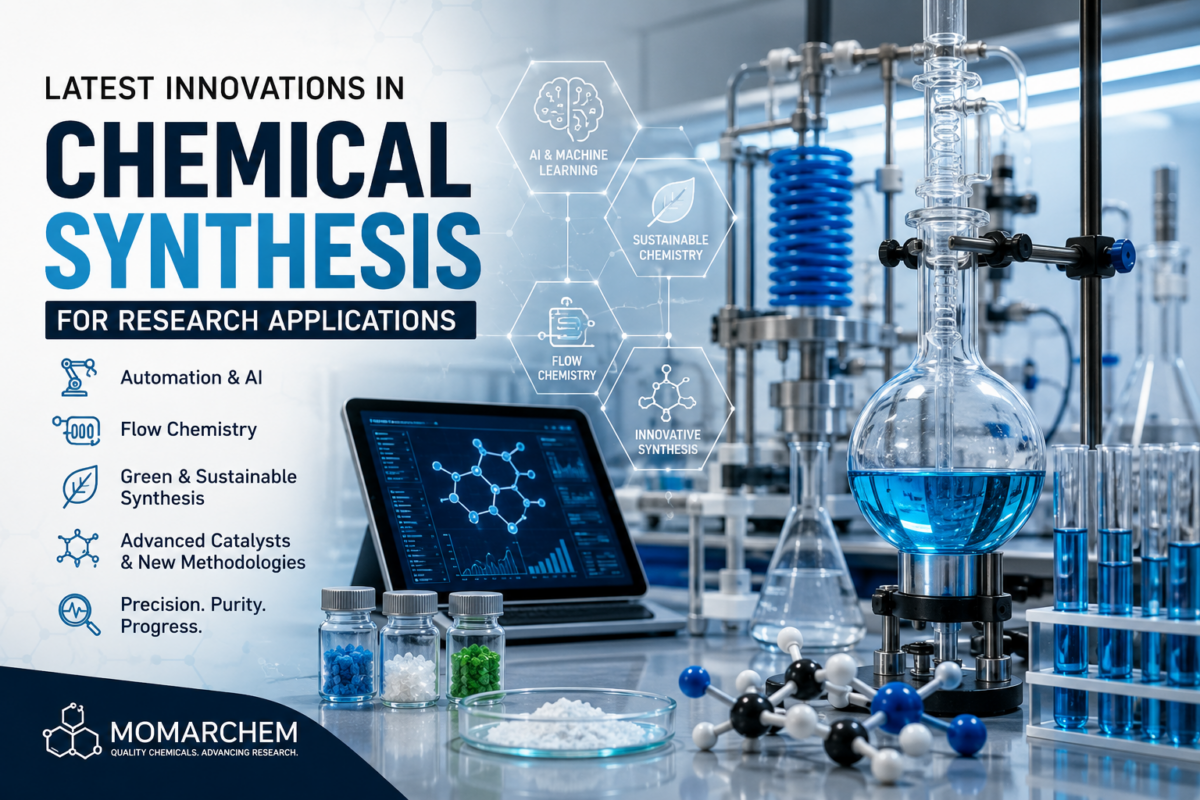
Latest Innovations in Chemical Synthesis for Research Applications
Latest Innovations in Chemical Synthesis for Research Applications
Chemical synthesis has always been at the heart of scientific discovery. From the creation of pharmaceutical compounds to the development of novel research chemicals, advances in synthesis techniques continue to shape modern chemistry. As research demands become increasingly complex, scientists are adopting innovative methods that improve precision, efficiency, scalability, and safety while reducing environmental impact.
Today’s laboratories have access to technologies that were unimaginable just a few decades ago. Artificial intelligence assists researchers in predicting reaction pathways, automated synthesis platforms reduce human error, and sustainable chemistry practices minimize waste without sacrificing product quality. These innovations are transforming how researchers develop, optimize, and analyze chemical compounds for scientific investigation.
For organizations and laboratories working with research chemicals, understanding these technological advancements is essential. Improved synthesis methods lead to higher purity compounds, better reproducibility, and more reliable experimental outcomes.
In this article, we’ll explore the latest innovations in chemical synthesis, their impact on scientific research, and how these developments are helping researchers achieve more accurate and efficient results.
Why Innovation in Chemical Synthesis Matters
Chemical synthesis is the process of constructing chemical compounds from simpler substances through carefully controlled reactions. Every advancement in synthesis technology provides researchers with new opportunities to produce compounds that are purer, safer, and more consistent.
Modern research often requires:
- High-purity compounds
- Precise molecular structures
- Excellent batch-to-batch consistency
- Faster production timelines
- Reduced environmental impact
- Improved laboratory safety
Traditional synthesis methods remain valuable, but many involve lengthy procedures, multiple purification steps, and significant solvent usage. Modern innovations address these challenges by introducing smarter and more efficient approaches.
The result is a scientific environment where researchers can spend less time overcoming technical limitations and more time focusing on discovery.
Automation in Chemical Synthesis
One of the biggest transformations in modern chemistry is laboratory automation.
Automated synthesis platforms perform repetitive laboratory tasks with exceptional precision. These systems accurately dispense reagents, control temperatures, monitor reaction conditions, and collect analytical data with minimal manual intervention.
Benefits include:
- Improved reproducibility
- Reduced human error
- Faster reaction optimization
- Higher laboratory efficiency
- Better documentation and traceability
Automation is particularly valuable for research involving large libraries of compounds. Instead of manually preparing hundreds of reactions, automated systems can produce multiple compounds simultaneously under carefully controlled conditions.
Researchers also benefit from standardized protocols, making it easier for different laboratories to reproduce published results.
Artificial Intelligence and Machine Learning
Artificial intelligence (AI) is becoming an increasingly important tool in chemical research.
Rather than replacing chemists, AI helps researchers make better decisions by analyzing enormous datasets that would take humans weeks or months to evaluate.
Modern AI systems assist with:
- Predicting reaction success
- Identifying optimal reaction conditions
- Designing synthetic pathways
- Selecting catalysts
- Reducing unnecessary experiments
- Optimizing yields
Machine learning models continuously improve as they process additional experimental data. This allows researchers to identify promising synthesis strategies more quickly than relying solely on traditional trial-and-error methods.
AI also accelerates the discovery of entirely new compounds by predicting molecular properties before laboratory synthesis begins.
Flow Chemistry: A Modern Alternative
Flow chemistry has become one of the most exciting developments in chemical synthesis.
Instead of conducting reactions in large stationary vessels, reactants continuously flow through specialized tubing or reactors where reactions occur under carefully controlled conditions.
Compared to traditional batch synthesis, flow chemistry offers several advantages:
- Better temperature control
- Improved reaction consistency
- Enhanced safety
- Reduced waste
- Easier scale-up
- Faster production
Continuous-flow systems also allow researchers to study highly reactive intermediates that may be difficult or dangerous to isolate using conventional methods.
For many research applications, flow chemistry provides greater efficiency while maintaining exceptional control over reaction parameters.
Green Chemistry and Sustainable Synthesis
Environmental responsibility has become a major focus in chemical research.
Green chemistry aims to reduce the environmental footprint of chemical synthesis by designing safer, cleaner, and more efficient processes.
Common green chemistry innovations include:
- Using environmentally friendly solvents
- Reducing hazardous reagents
- Improving atom economy
- Lowering energy consumption
- Recycling catalysts
- Minimizing chemical waste
Many laboratories now evaluate synthetic routes not only by yield but also by sustainability metrics.
These improvements help reduce costs while supporting responsible scientific research and safer laboratory practices.
Advanced Catalysts: Increasing Efficiency and Selectivity
Catalysts have long been essential in chemical synthesis, but modern catalytic systems have become significantly more sophisticated. Researchers now have access to catalysts designed to improve reaction speed, increase yields, and favor the formation of specific products while minimizing unwanted by-products.
Recent innovations include:
- Organocatalysts, which use small organic molecules instead of metals to drive reactions.
- Biocatalysts (enzymes) that enable highly selective reactions under mild conditions.
- Nanocatalysts, which provide large reactive surface areas and can improve reaction efficiency.
- Reusable heterogeneous catalysts that are easier to separate from reaction mixtures and can reduce waste.
By carefully selecting the appropriate catalyst, researchers can streamline synthesis workflows and improve the consistency of their results.
Microwave-Assisted Chemical Synthesis
Microwave-assisted synthesis has become a valuable tool for accelerating chemical reactions. Unlike conventional heating methods, microwave energy heats reaction mixtures rapidly and more uniformly.
Potential benefits include:
- Shorter reaction times
- Improved product yields
- Lower energy consumption
- Enhanced reaction control
- Reduced formation of unwanted side products
Many reactions that traditionally require several hours may be completed much more quickly under optimized microwave-assisted conditions. This makes the technique especially useful during reaction screening and method development.
Researchers continue to explore microwave-assisted approaches across a wide range of synthetic applications due to their efficiency and reproducibility.
Photochemistry: Harnessing Light for Chemical Reactions
Photochemistry uses light as an energy source to initiate or influence chemical reactions. Advances in LED technology and photoreactor design have made photochemical methods more practical and accessible in research laboratories.
Applications include:
- Selective bond formation
- Functionalization of complex molecules
- Generation of reactive intermediates
- Development of novel synthetic pathways
Because light can provide highly controlled activation energy, photochemical reactions may proceed under milder conditions than some conventional approaches. This can improve selectivity and expand the range of accessible molecular transformations.
Electrochemical Synthesis
Electrochemical synthesis is attracting growing interest as an alternative to traditional oxidation and reduction methods.
Instead of relying on stoichiometric chemical reagents, electrochemical systems use electrical current to promote chemical transformations. This approach can reduce the need for hazardous oxidizing or reducing agents while offering precise control over reaction conditions.
Advantages may include:
- Reduced chemical waste
- Improved reaction selectivity
- Lower reagent consumption
- Better process control
- Opportunities for greener synthetic routes
As equipment becomes more accessible, electrochemical methods are expected to play an increasingly important role in modern chemical research.
3D Printing and Custom Laboratory Equipment
Three-dimensional printing has introduced new possibilities for laboratory customization. Researchers can now design and manufacture specialized equipment tailored to specific experimental needs.
Examples include:
- Custom reaction vessels
- Flow chemistry components
- Mixing devices
- Microreactors
- Laboratory adapters and fittings
Rapid prototyping allows scientists to test new reactor designs efficiently without relying solely on commercially available equipment. This flexibility supports innovation and can help optimize experimental workflows.
High-Throughput Experimentation
High-throughput experimentation (HTE) enables researchers to evaluate many reaction conditions simultaneously. By testing numerous combinations of catalysts, solvents, temperatures, and reagent ratios in parallel, laboratories can identify optimal conditions much faster than with traditional one-at-a-time approaches.
Benefits include:
- Faster reaction optimization
- Efficient screening of synthetic routes
- Reduced material consumption
- Improved data generation
- Better reproducibility
When combined with automation and machine learning, HTE significantly accelerates research and development efforts.
Improved Analytical Technologies
Advances in analytical chemistry complement innovations in synthesis by allowing researchers to verify compound identity, purity, and structural integrity with greater confidence.
Common analytical techniques include:
- Nuclear Magnetic Resonance (NMR) spectroscopy
- Liquid Chromatography (LC)
- Gas Chromatography (GC)
- Mass Spectrometry (MS)
- Infrared (IR) spectroscopy
- High-Performance Liquid Chromatography (HPLC)
These tools help researchers confirm that synthesized compounds meet the required specifications before they are used in further scientific investigations.
Accurate analytical verification is a cornerstone of reliable chemical research and supports reproducible experimental outcomes.
Quality Control Remains Essential
Even with cutting-edge synthesis technologies, robust quality control remains indispensable. Careful monitoring throughout the synthesis process helps ensure that compounds are produced consistently and meet established quality standards.
A comprehensive quality control process may involve:
- Verification of raw material quality
- Monitoring of reaction conditions
- Purification and isolation procedures
- Analytical testing for identity and purity
- Documentation and batch records
Reliable quality assurance helps researchers obtain materials suitable for reproducible laboratory studies and contributes to the overall integrity of scientific research.
The Future of Chemical Synthesis
Chemical synthesis continues to evolve rapidly, driven by advances in automation, artificial intelligence, sustainable practices, and analytical science. Future laboratories are likely to integrate autonomous systems capable of planning, executing, monitoring, and optimizing reactions with minimal human intervention.
Emerging areas of interest include:
- Self-driving laboratories
- AI-guided molecular design
- Advanced robotic synthesis platforms
- Digital twins for reaction modeling
- More sustainable catalytic systems
- Continuous manufacturing technologies
These innovations have the potential to shorten development timelines, improve reproducibility, and expand the range of compounds available for scientific research.
As these technologies mature, researchers will have even greater opportunities to explore complex chemical systems with improved precision and efficiency.
Frequently Asked Questions
What is chemical synthesis?
Chemical synthesis is the process of creating chemical compounds through controlled chemical reactions using simpler starting materials.
Why is automation important in chemical synthesis?
Automation improves reproducibility, reduces human error, increases laboratory efficiency, and enables researchers to perform complex experiments more consistently.
What is flow chemistry?
Flow chemistry is a technique in which reactants continuously move through a reactor rather than reacting in a traditional batch vessel. It offers improved control, safety, and scalability for many applications.
How does artificial intelligence support chemical research?
AI can analyze large datasets, predict reaction outcomes, suggest optimized reaction conditions, and assist researchers in designing efficient synthetic pathways.
Why is green chemistry important?
Green chemistry promotes safer and more sustainable chemical processes by reducing hazardous substances, minimizing waste, improving energy efficiency, and encouraging environmentally responsible practices.
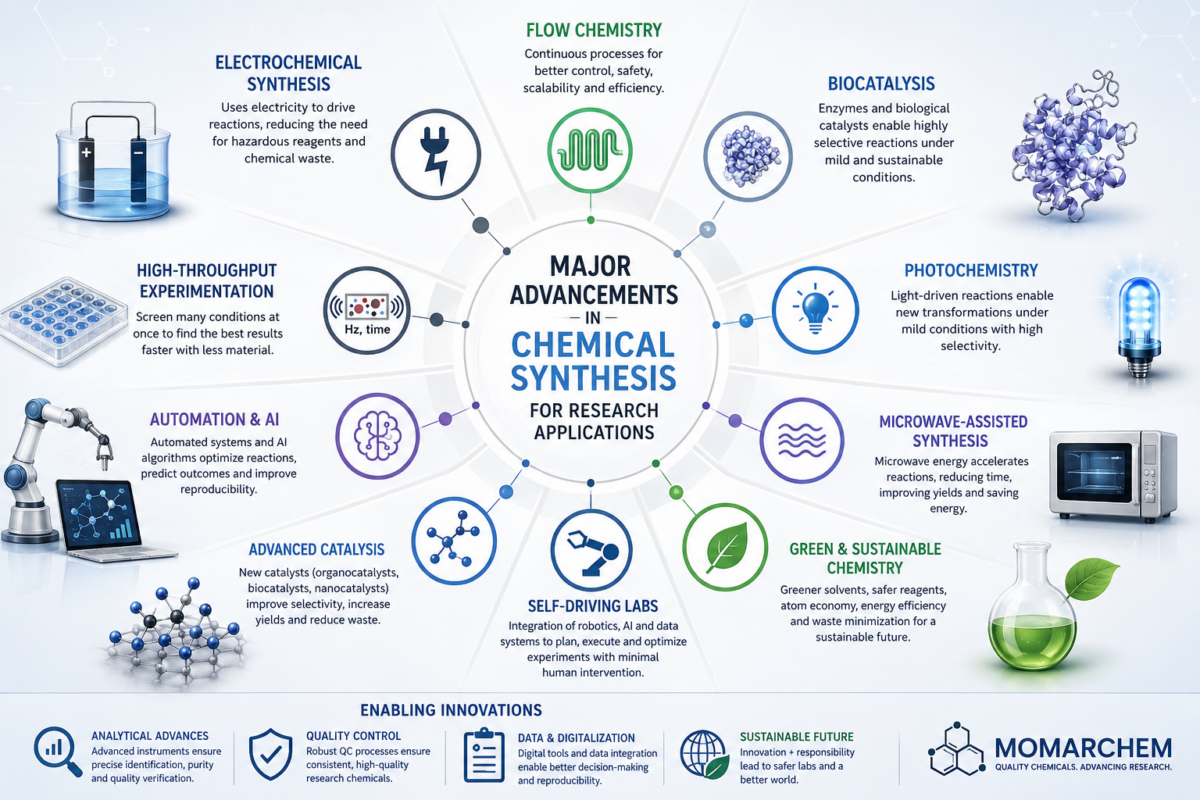
Innovations in chemical synthesis are transforming the way researchers design, produce, and evaluate chemical compounds. Technologies such as automation, artificial intelligence, flow chemistry, advanced catalysis, photochemistry, electrochemical synthesis, and high-throughput experimentation are making research more efficient, reproducible, and environmentally conscious.
Equally important are the analytical and quality control methods that ensure synthesized compounds meet the standards required for reliable scientific investigation. As the field continues to evolve, researchers can expect even greater precision, faster development cycles, and more sustainable approaches to chemical synthesis.
At Momarchem, we recognize the importance of quality, consistency, and scientific integrity. We are committed to supplying high-quality research chemicals that support laboratories and researchers in advancing scientific knowledge through dependable materials and rigorous quality standards.