
Chemicals
Citric Acid (CAS 77-92-9): Properties, Applications, and Laboratory Uses
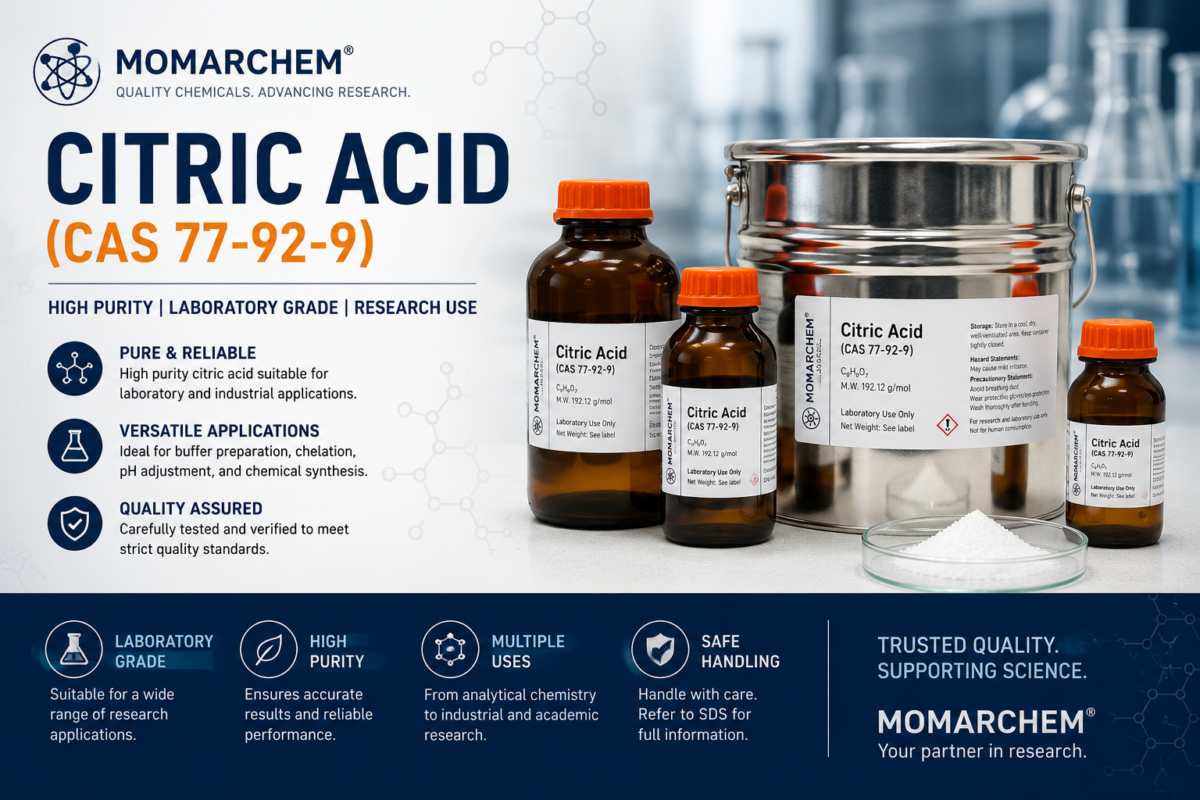
Citric acid is one of the most widely recognized organic acids in chemistry. Naturally present in citrus fruits and produced commercially through microbial fermentation, it is valued for its acidity, metal-chelating ability, and buffering properties. In scientific laboratories, citric acid is used as a reagent, pH adjuster, and component of buffer systems, while it also plays important roles in pharmaceutical, food, cosmetic, and industrial formulations.
With the molecular formula C₆H₈O₇, citric acid belongs to the family of tricarboxylic acids. Its three carboxyl groups allow it to participate in a wide variety of chemical reactions and make it an effective complexing agent for metal ions. Because of these characteristics, it is frequently used in analytical chemistry, biochemistry, environmental science, and formulation research.
This article explores the chemical properties, laboratory applications, safety considerations, and importance of Citric Acid (CAS 77-92-9) in modern scientific research.
Chemical Identification
| Property | Value |
|---|---|
| Chemical Name | Citric Acid |
| CAS Number | 77-92-9 |
| Molecular Formula | C₆H₈O₇ |
| Molecular Weight | 192.12 g/mol |
| IUPAC Name | 2-Hydroxypropane-1,2,3-tricarboxylic acid |
| Appearance | White crystalline powder |
| Odor | Odorless |
| Solubility | Highly soluble in water |
| Melting Point | Approximately 153°C (decomposes) |
Chemical Structure and Properties
Citric acid contains three carboxylic acid groups and one hydroxyl group, giving it unique chemical behavior. These functional groups enable the compound to donate protons, participate in esterification reactions, and bind metal ions effectively.
Key properties include:
- Weak organic acid
- Excellent buffering capability
- Effective metal chelator
- Water soluble
- Biodegradable
- Stable under recommended storage conditions
These characteristics make citric acid valuable in both laboratory and industrial environments.
Laboratory Applications
Citric acid is widely used in research laboratories for a variety of purposes, including:
Buffer Preparation
Citric acid is commonly combined with sodium citrate to prepare citrate buffer solutions across a broad pH range.
Analytical Chemistry
Researchers use citric acid in analytical procedures requiring pH control or metal ion complexation.
Metal Chelation
The compound effectively binds calcium, magnesium, iron, and other metal ions, making it useful in numerous experimental protocols.
Biochemistry
Citric acid is frequently incorporated into biochemical assays and cell culture workflows where controlled pH conditions are required.
Chemical Synthesis
It can serve as an acid catalyst or reagent in selected laboratory-scale synthesis procedures.
Industrial Applications
Beyond the laboratory, citric acid is widely used in:
- Pharmaceutical formulations
- Food and beverage production
- Cosmetics
- Cleaning products
- Water treatment
- Agricultural formulations
- Biotechnology
- Personal care products
Its versatility stems from its acidity, safety profile, and biodegradability.
Importance in Scientific Research
Citric acid is an important compound in numerous scientific disciplines.
Researchers utilize it in studies involving:
- Biochemistry
- Environmental chemistry
- Pharmaceutical sciences
- Materials science
- Analytical chemistry
- Chemical engineering
- Biotechnology
It also plays a central role in studies of the citric acid (Krebs) cycle, one of the most fundamental metabolic pathways in living organisms.
Storage Recommendations
To maintain product quality, citric acid should generally be stored:
- In a cool, dry environment
- In tightly sealed containers
- Protected from moisture
- Away from incompatible chemicals
- In accordance with applicable laboratory safety procedures
Always follow the manufacturer’s storage guidance and institutional laboratory protocols.
Safety Considerations
Although citric acid is widely used, appropriate laboratory safety practices should always be followed.
Researchers should:
- Wear appropriate personal protective equipment (PPE)
- Avoid inhalation of dust
- Prevent prolonged skin or eye contact
- Work in accordance with institutional safety guidelines
- Consult the relevant Safety Data Sheet (SDS) before handling
Why Choose High-Quality Citric Acid?
Using high-quality laboratory reagents helps improve:
- Experimental reproducibility
- Analytical accuracy
- Batch consistency
- Reliable research outcomes
Researchers should obtain chemicals from trusted suppliers that emphasize quality control and proper documentation.
Frequently Asked Questions
What is the CAS number for citric acid?
The CAS number for citric acid is 77-92-9.
Is citric acid soluble in water?
Yes. Citric acid is highly soluble in water, making it suitable for preparing aqueous solutions and buffer systems.
What is citric acid used for in laboratories?
It is commonly used for buffer preparation, pH adjustment, metal chelation, analytical chemistry, biochemical research, and chemical synthesis.
Why is citric acid important in biochemistry?
Citric acid is a key intermediate in the Krebs (citric acid) cycle, which is central to cellular energy metabolism.
How should citric acid be stored?
Store it in a tightly sealed container in a cool, dry place away from moisture and incompatible substances, following laboratory safety recommendations.
Citric Acid (CAS 77-92-9) is a versatile organic acid with broad applications in scientific research, analytical chemistry, biochemistry, pharmaceuticals, and industrial processes. Its buffering capacity, metal-chelating properties, and high water solubility make it an indispensable reagent in many laboratory settings. Whether used in buffer preparation, analytical methods, or biochemical studies, citric acid continues to play a significant role in advancing scientific research.
At Momarchem, we are committed to providing high-quality research chemicals that support laboratories, educational institutions, and research professionals. Our focus on quality, consistency, and reliable service helps researchers obtain dependable materials for their scientific work.