
Chemicals
Understanding Tryptamines: Structure, Effects, and Research Applications
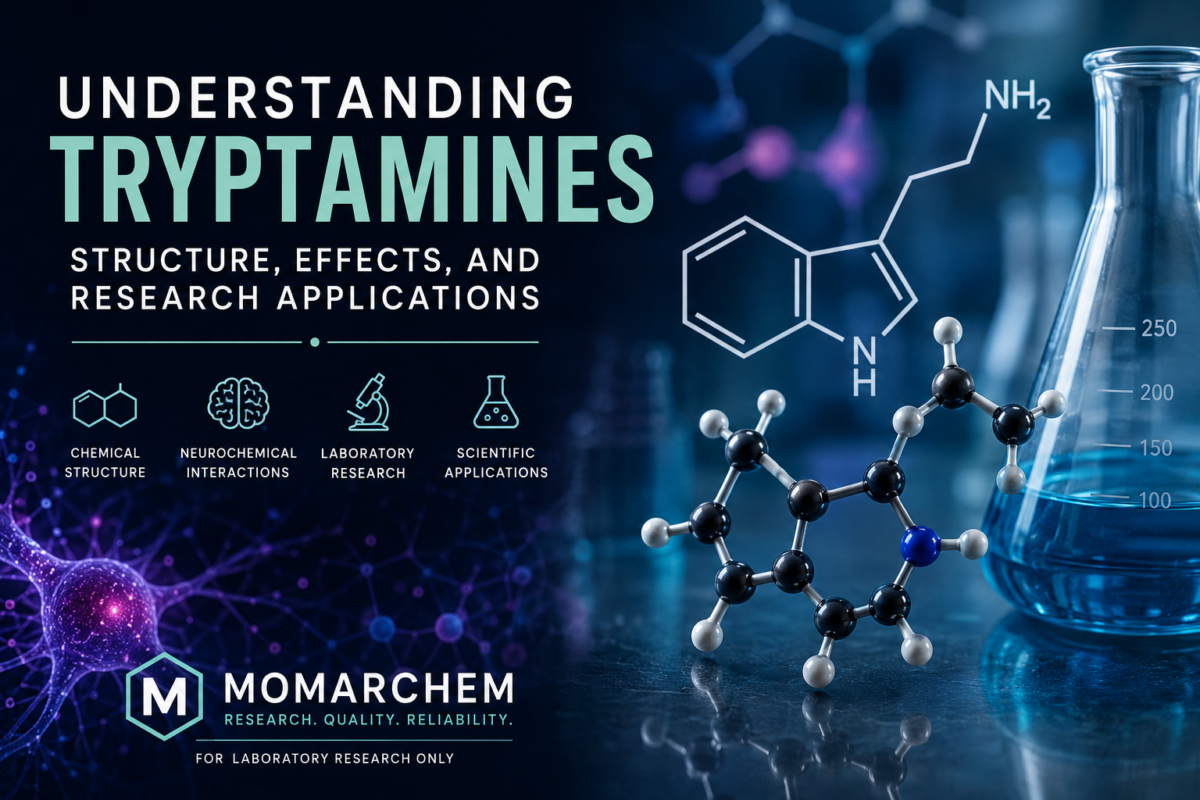
Tryptamines are a diverse class of organic compounds that play an important role in chemistry, biochemistry, neuroscience, and laboratory research. Naturally occurring and synthetic tryptamines have attracted significant scientific interest because of their unique molecular structures and their interactions with biological systems. Researchers continue to investigate these compounds to better understand receptor activity, neurotransmission, molecular pharmacology, and structure-activity relationships.
At Momarchem, we provide high-quality research chemicals intended exclusively for legitimate laboratory and scientific research. This article explores the chemistry of tryptamines, their structural characteristics, common subclasses, and their importance in modern research.
What Are Tryptamines?
Tryptamines are organic compounds built around the indole ring system connected to an aminoethyl side chain. This structural framework is closely related to the naturally occurring amino acid tryptophan, making tryptamines an important family of compounds in biological and chemical research.
Many naturally occurring molecules found in plants, fungi, animals, and humans belong to the tryptamine family. Scientists have also synthesized numerous tryptamine analogs to study how structural modifications influence biological activity.
The versatility of the tryptamine structure has made these compounds valuable tools for investigating receptor binding, enzyme interactions, neurotransmitter systems, and medicinal chemistry.
Basic Chemical Structure
The defining feature of every tryptamine is its core molecular framework, consisting of:
- An indole ring (a fused benzene and pyrrole ring)
- A two-carbon ethyl chain
- A terminal amino group
Small changes to this structure can significantly alter a compound’s chemical properties and receptor affinity. Researchers often modify different positions on the indole ring or substitute groups on the amino nitrogen to study structure-activity relationships (SAR).
These controlled structural variations help scientists better understand molecular recognition and receptor selectivity.
Naturally Occurring Tryptamines
Several naturally occurring compounds belong to the tryptamine family and are essential subjects of scientific research.
Tryptamine
Tryptamine itself serves as the parent compound for many derivatives. It occurs naturally in small quantities in various plants, animals, and microorganisms and acts as an important intermediate in biochemical pathways.
Serotonin (5-Hydroxytryptamine)
Serotonin is one of the best-known naturally occurring tryptamines. It functions as a neurotransmitter involved in numerous physiological processes, making it an important molecule in neuroscience and pharmacological research.
Researchers continue studying serotonin receptors to improve understanding of neurological signaling pathways.
Melatonin
Melatonin is another naturally occurring tryptamine derivative involved in circadian rhythm regulation. It remains an important compound for research into sleep biology, endocrinology, and chronobiology.
Synthetic Tryptamines
Chemists have synthesized many tryptamine derivatives for laboratory investigations. These compounds allow researchers to examine how structural modifications affect receptor binding, metabolism, and molecular interactions.
Examples of commonly studied synthetic tryptamine classes include compounds with substitutions at various positions on the indole ring or modifications to the amino side chain. Such compounds are frequently investigated in receptor pharmacology, analytical chemistry, and medicinal chemistry research.
Their diversity makes synthetic tryptamines valuable reference materials for laboratories studying neurotransmitter systems and molecular mechanisms.
Importance in Scientific Research
Tryptamines are valuable research tools because they interact with multiple biological targets. Scientists use them in carefully controlled laboratory environments to investigate:
- Structure-activity relationships (SAR)
- Receptor binding mechanisms
- Neurochemical signaling pathways
- Molecular pharmacology
- Drug discovery research
- Analytical method development
- Chemical synthesis techniques
- Biochemical interactions
Insights gained from these studies contribute to broader scientific knowledge and may inform future therapeutic research.
Structure-Activity Relationship Studies
One major area of tryptamine research involves understanding how small molecular changes influence biological activity.
Researchers examine factors such as:
- Ring substitutions
- Side-chain length
- Nitrogen substitutions
- Electronic properties
- Molecular flexibility
- Lipophilicity
These investigations help scientists understand why closely related molecules may exhibit very different receptor affinities and chemical behaviors.
Structure-activity relationship studies remain a cornerstone of medicinal chemistry and pharmaceutical research.
Analytical Research Applications
Analytical laboratories frequently use tryptamines when developing and validating analytical methods.
Common techniques include:
- High-performance liquid chromatography (HPLC)
- Gas chromatography (GC)
- Liquid chromatography-mass spectrometry (LC-MS)
- Gas chromatography-mass spectrometry (GC-MS)
- Nuclear magnetic resonance (NMR)
- Infrared spectroscopy (IR)
These methods help researchers accurately identify compounds, determine purity, characterize molecular structures, and establish reliable laboratory procedures.
Safe Laboratory Handling
As with all research chemicals, proper laboratory practices are essential when working with tryptamines.
Recommended laboratory procedures include:
- Using appropriate personal protective equipment (PPE)
- Working in well-equipped laboratory environments
- Proper chemical labeling
- Secure storage in tightly sealed containers
- Maintaining accurate documentation
- Following institutional safety protocols
- Complying with all applicable regulations
Research chemicals should only be handled by qualified professionals operating in legitimate research settings.
Choosing High-Quality Research Chemicals
The quality of research chemicals can significantly influence experimental reliability and reproducibility.
When sourcing laboratory materials, researchers should consider suppliers that provide:
- High-purity products
- Batch consistency
- Certificate of Analysis (COA), where available
- Reliable packaging
- Accurate product documentation
- Professional customer support
- Transparent quality assurance practices
Reliable sourcing helps improve confidence in laboratory results and supports reproducible scientific research.
Momarchem’s Commitment to Research Quality
At Momarchem, quality is central to everything we do. We are committed to supplying research chemicals that meet the needs of universities, analytical laboratories, research institutions, and qualified scientific professionals.
Our focus includes:
- Rigorous quality control procedures
- Reliable product consistency
- Secure packaging
- Professional customer service
- Efficient order processing
- Commitment to scientific integrity
Every product offered by Momarchem is intended solely for legitimate laboratory and scientific research purposes.
Tryptamines represent one of the most significant classes of compounds in modern chemical and biochemical research. Their unique molecular structure and diverse derivatives make them indispensable tools for studying receptor pharmacology, neurotransmission, analytical chemistry, and medicinal chemistry.
As scientific understanding continues to evolve, tryptamines remain valuable compounds for advancing laboratory research and expanding knowledge of molecular interactions. By sourcing high-quality research chemicals from trusted suppliers such as Momarchem, laboratories can conduct studies with greater confidence in product consistency and reliability.
Disclaimer: The products supplied by Momarchem are intended for laboratory research, analytical, and scientific purposes only. They are not intended for human or veterinary use. Researchers are responsible for complying with all applicable laws, regulations, and institutional guidelines regarding the handling and use of research chemicals.