
Chemicals
The Science of Psychoactive Compounds:Understanding Neurotransmitters, Receptors, and the Chemistry Behind Brain Function
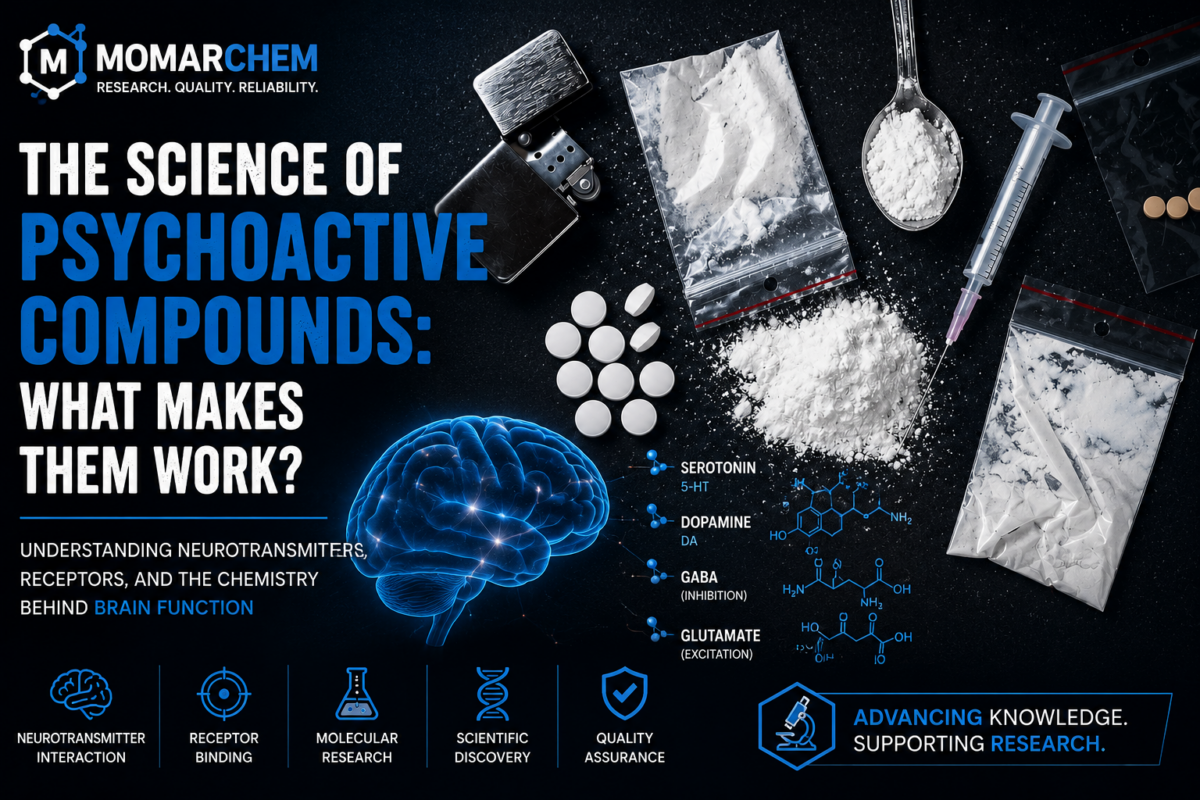
The Science of Psychoactive Compounds: What Makes Them Work?
Psychoactive compounds have fascinated researchers for decades due to their ability to interact with the brain and influence perception, cognition, mood, and behavior. From naturally occurring molecules to synthetic research chemicals, these compounds provide valuable insights into neuroscience, pharmacology, and human physiology.
Understanding how psychoactive compounds work requires examining the complex interactions between chemical structures, neurotransmitter systems, and receptor networks within the brain. This knowledge helps researchers explore the mechanisms behind consciousness, cognition, and neurochemical communication.
In this article, we explore the science of psychoactive compounds, the biological systems they affect, and why they remain an important area of scientific research.
What Are Psychoactive Compounds?
Psychoactive compounds are substances capable of affecting the central nervous system (CNS). These compounds influence brain function by interacting with neurotransmitters and receptors that regulate communication between neurons.
Depending on their mechanism of action, psychoactive compounds may alter:
- Perception
- Mood
- Memory
- Attention
- Cognition
- Sensory processing
- Emotional responses
Researchers study psychoactive substances to better understand how the brain functions and how chemical signaling influences behavior.
Understanding Neurotransmitters
To understand how psychoactive compounds work, it is important to understand neurotransmitters.
Neurotransmitters are chemical messengers that transmit signals between neurons throughout the nervous system.
Major neurotransmitter systems include:
Serotonin (5-HT)
Serotonin plays a role in:
- Mood regulation
- Sleep cycles
- Appetite
- Sensory processing
- Cognitive function
Many psychoactive compounds interact with serotonin receptors, making this one of the most studied neurotransmitter systems in neuropharmacology.
Dopamine
Dopamine is involved in:
- Motivation
- Reward processing
- Learning
- Movement
- Reinforcement mechanisms
Research compounds that influence dopamine pathways help scientists study behavioral and neurological processes.
Glutamate
Glutamate is the brain’s primary excitatory neurotransmitter.
It plays a critical role in:
- Learning
- Memory formation
- Neural plasticity
- Cognitive function
Many dissociative compounds interact with glutamate receptor systems, particularly NMDA receptors.
GABA
Gamma-Aminobutyric Acid (GABA) serves as the brain’s primary inhibitory neurotransmitter.
Functions include:
- Reducing neuronal activity
- Promoting relaxation
- Maintaining neurological balance
Researchers often investigate compounds that influence GABA signaling to better understand neural regulation.
The Importance of Receptors
Neurotransmitters communicate with neurons through specialized proteins known as receptors.
Think of receptors as locks and neurotransmitters as keys. When a specific molecule binds to a receptor, a biological response occurs.
Different psychoactive compounds may:
- Activate receptors
- Block receptors
- Enhance neurotransmitter activity
- Reduce neurotransmitter activity
- Modify signaling pathways
The specific receptors affected largely determine a compound’s pharmacological profile.
How Psychoactive Compounds Influence the Brain
Agonists
Agonists bind to receptors and activate them, producing a biological response similar to the body’s natural neurotransmitters.
Researchers study agonists to understand receptor function and signaling pathways.
Antagonists
Antagonists bind to receptors without activating them.
Instead, they block receptor activity and prevent neurotransmitters from producing their normal effects.
These compounds help researchers investigate the role of specific receptors within the nervous system.
Partial Agonists
Partial agonists activate receptors but produce weaker responses than full agonists.
These compounds are valuable research tools because they can reveal subtle differences in receptor behavior.
Reuptake Inhibitors
Some psychoactive compounds increase neurotransmitter availability by preventing their reabsorption.
This allows neurotransmitters to remain active for longer periods within the synaptic space.
Researchers use these compounds to study neurotransmitter regulation and neural communication.
Major Classes of Psychoactive Research Compounds
Tryptamines
Tryptamines are among the most extensively studied psychoactive compounds.
Researchers investigate tryptamines for their interactions with serotonin receptor systems and their ability to provide insights into sensory processing and neuropharmacology.
Examples include:
- 4-HO compounds
- 4-AcO compounds
- MET analogs
- DPT analogs
Phenethylamines
Phenethylamines represent a diverse class of compounds with broad applications in pharmacological research.
Studies often focus on:
- Structure-activity relationships
- Neurotransmitter interactions
- Receptor binding characteristics
Lysergamides
Lysergamides possess complex molecular structures and are frequently studied for their high receptor affinity and unique pharmacological properties.
Researchers use these compounds to explore:
- Receptor selectivity
- Molecular signaling
- Neurochemical mechanisms
Dissociatives
Dissociative compounds primarily affect glutamate signaling systems.
Research in this area helps scientists better understand:
- Cognitive processing
- Neural connectivity
- Memory systems
- Brain network function
Synthetic Cannabinoids
Synthetic cannabinoids interact with cannabinoid receptors and provide important tools for studying the endocannabinoid system.
Researchers examine their effects on:
- Neural communication
- Receptor activity
- Signal transduction pathways
Structure-Activity Relationships (SAR)
One of the most important concepts in psychoactive compound research is Structure-Activity Relationships (SAR).
SAR investigates how changes to molecular structure influence biological activity.
Even small modifications can affect:
- Receptor affinity
- Metabolic stability
- Duration of action
- Pharmacological profile
- Molecular selectivity
Understanding SAR allows researchers to predict how novel compounds may behave before extensive testing occurs.
This field remains a cornerstone of medicinal chemistry and pharmacological research.
Why Researchers Study Psychoactive Compounds
The study of psychoactive compounds contributes to several scientific disciplines.
Neuroscience
Researchers use psychoactive compounds to investigate:
- Brain function
- Neural pathways
- Neurotransmitter systems
- Cognitive processes
Pharmacology
Novel compounds provide valuable information about:
- Drug-receptor interactions
- Molecular signaling
- Pharmacodynamics
- Pharmacokinetics
Medicinal Chemistry
Studying psychoactive compounds helps scientists understand how molecular modifications influence biological activity.
Analytical Chemistry
The emergence of new compounds drives innovation in:
- Compound identification
- Purity analysis
- Spectroscopic characterization
- Laboratory testing methods
The Role of Analytical Testing
Reliable scientific research depends on accurate compound characterization.
Common analytical methods include:
High-Performance Liquid Chromatography (HPLC)
Used to assess purity and identify impurities.
Gas Chromatography-Mass Spectrometry (GC-MS)
Provides detailed chemical identification and molecular analysis.
Nuclear Magnetic Resonance (NMR)
Confirms molecular structure and composition.
Fourier Transform Infrared Spectroscopy (FTIR)
Helps identify compounds through molecular fingerprinting.
These techniques support quality assurance and help researchers verify compound identity.
Quality and Transparency in Research Chemicals
For meaningful scientific investigation, researchers must have confidence in the materials they use.
Important considerations include:
- Verified purity
- Batch consistency
- Reliable analytical documentation
- Transparent testing procedures
- Reputable sourcing practices
At Momarchem, quality assurance remains a fundamental priority. Through rigorous testing standards and transparent documentation, researchers can access materials designed to support accurate and reproducible scientific investigations.
The Future of Psychoactive Compound Research
Scientific interest in psychoactive compounds continues to expand.
Emerging areas of research include:
- Advanced receptor mapping
- Computational chemistry
- Predictive molecular modeling
- Neuroplasticity studies
- Novel compound development
As analytical technologies improve and scientific understanding deepens, psychoactive compounds will continue providing valuable insights into the mechanisms that govern brain function and human behavior.
The science of psychoactive compounds centers on understanding how molecules interact with neurotransmitters, receptors, and neural networks. Through studies involving serotonin, dopamine, glutamate, GABA, and other signaling systems, researchers continue uncovering important details about cognition, behavior, and neurobiology.
Whether examining tryptamines, phenethylamines, lysergamides, dissociatives, or synthetic cannabinoids, the study of psychoactive compounds remains a critical area of modern scientific research. By combining rigorous analytical testing with high-quality research materials, scientists can continue advancing our understanding of the brain and the complex chemistry that drives human experience.